skip to main |
skip to sidebar
 *Mr. X gives a free class to farmers..*name changed to protect privacy
 Black Michael Jackson with Blue Towel Hair... Limited Edition!!! Offer Valid while supplies(1) last...
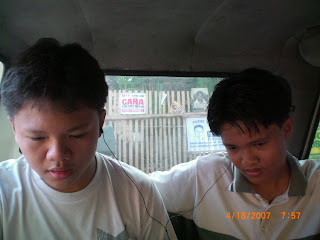 Jamming....0_o
1. First, The "Sir Harold" Visitation
Sir came to wait with us for the PhilRice service. At PhilRice, he talked a bit with "Sir Dario" about our welfare. This all happened while we were counting insects.
2. Counting Insects
We.... counted..... insects....
3. Last, AESA (Agroecosystem Analysis)
We went by partner and chose a 1 square meter quadrant... and analyzed it. 5 hills , different crop damage percents, varying number of insects, 1 quadrant. Which hill is the healthiest??
Posted by: Dellomes
hill- group of paniclespanicle- holds the spikeletsspikelets- rice protected by a hullhull- protection of the ricegrain moisture meter- used to measure grain moisturethresh- to get the spikelets from the paniclescropcut- harvesting off crop within 3 5 square meter quadrants in a diagonal form considering the border effect. The harvested crop spikelets are then used for data in research mattersborder effect- the tendency for crops within 1 meter of the border of the paddy to be more cared for than those nearer to the center; therefore, any data derived fom these crops near the border is considered biasedGPS (Global Positioning System)- system consisting of 24 satellites, each set with a specific and highly precise orbit, receivers, and a central control station that is located in the U.S.. GPS gives location in terms of longitude and latitude, exact time, graphical imagery, and some other data concerning locations. Developed by the U.S. D.o.D.(Department of Defense), it was soon released to civilian use but with considerable errors in the data.
Posted by: PhilRice Boys!!
1. First, Not again!!! 1,000,000,000,ooo,oo1, 1,000,000,000,ooo,oo2....
The non-stop counting of spikelets. First, we harvested 5 panicles for each plot. Then we again threshed and counted it. Was it boring or was it not?
2. Last, The Setup of the Great Light Trap
First of all, a light trapis a trap that will trap insects. The insects trapped will be counted by their own kind and the countings will be the researchers data. Light traps are little house-like structures that has light in the center. The insects will then be led to a "balde" that has detergent powder, water and alcohol. Though it may catch as many insects, the data it may give is a bit non-significant because in every square meter, there are different kinds of insect that may go there. The setup was only to mix the ingredients of the liquid that will be put in the "balde". It was easy.
Posted by: Dellomes
1. First, Staff MeetingWe... sat there and looked efficient.2. Encoding Last Friday's dataAgain, not much except that we had an eventful time rediscovering Microsoft Excel's many functions.3. Last, Learning The GPRS.. I mean, The GPSWe were treated to a Powerpoint Presentation with regards to GPS (Global Positioning System). We were taught about the many practicalities of GPS. We were also shown the GPS receiver, a cellular phone-like affair that serves as a receiver for GPS satellite radiowaves. We were introduced to a computer program where GPS data is uploaded.
Posted by: Dellomes


